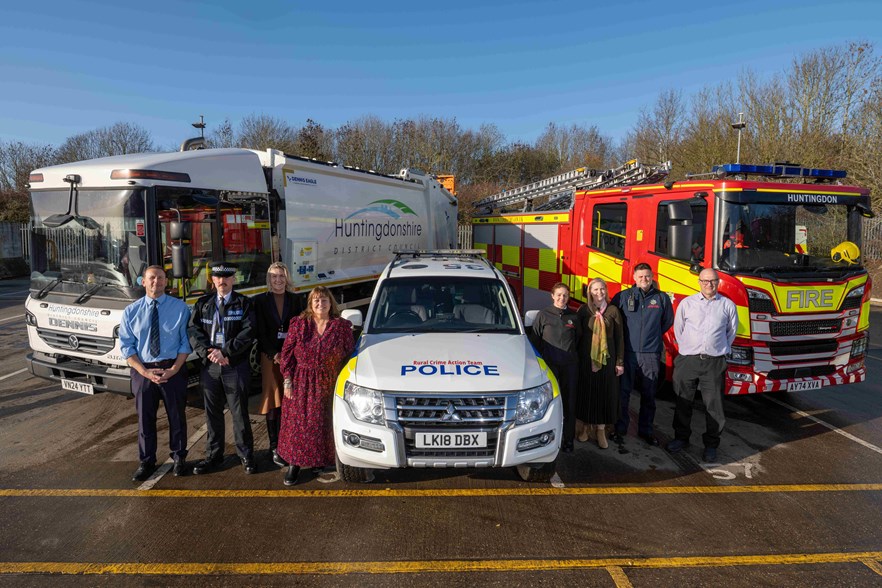
From bin lorries to blue lights: Huntingdonshire District Council’s partnership with the emergency services cuts carbon fleet emissions by over 80 per cent
02/12/2025
Huntingdonshire District Council (HDC) alongside Cambridgeshire Fire and Rescue Service and Cambridgeshire Constabulary have celebrated a successful, landmark trial resulting in an 80 per cent reduction of carbon emissions from fleet vehicles.
During the eight-month pilot, HDC trialled the use of hydrotreated vegetable oil (HVO) on a number of its own plant and machinery vehicles. Following a unanimous vote by the HDC Cabinet, in September the use of HVO was adopted across the council’s entire operational and pool fleet of 95 vehicles.
With vehicle fleet emissions accounting for over a third of HDC’s carbon footprint, the switch from fossil diesel to HVO has already made a significant contribution to reducing the council’s carbon footprint by around 1,100 tonnes of CO2 a year - roughly a 30 per cent reduction in overall emissions.
Cllr Sarah Conboy, Executive Leader for Huntingdonshire District Council, said: “We have taken our responsibility to reduce carbon emissions seriously. This trial shows that practical, innovative solutions can deliver real change without disrupting essential services.
“What makes this achievement even more significant is the spirit of collaboration behind it. We weren’t required to work with the emergency services, but we chose to, because we know that shared ambition accelerates progress. By opening up our infrastructure and testing new technologies together, we’ve created a model that others can adopt.
“As more councils and public bodies explore alternatives to fossil fuels, we hope our experience demonstrates that bold action is possible now. Climate change demands urgency, and this project is a clear example of how local authorities can take decisive steps to reduce emissions while continuing to deliver for residents. We’re proud to lead the way and will keep pushing for cleaner, greener solutions across all our operations."
HVO - a cleaner and renewable alternative to fossil diesel is made from waste vegetable oils. It can be used on its own or blended with diesel, meaning that vehicles can refuel anywhere without downtime, disruption to service or impact on performance.
As well as trialling the fuel switch within their own vehicles, the council invited the emergency services to join the pilot, with both Cambridgeshire Fire and Rescue Service and Cambridgeshire Constabulary - located within three miles of HDC’s HVO tank at Eastfield House - choosing to participate.
Like many public sector organisations, HDC has a strategic commitment to decarbonisation. The emergency services are no different, facing tight operational constraints and competing pressures on reducing their carbon footprint and becoming more sustainable.
Seven Police vehicles - a mix of marked and unmarked vehicles across various makes and models - ran on HVO fuel during the trial. Officers noted the benefits of HVO as a drop-in fuel, enabling vehicles to switch between diesel and on long rural shifts. 24/7 access to the fuel from a location close to their headquarters alongside slick finance processes made adoption straightforward.
For Cambridgeshire Fire and Rescue Service, the trial complemented their broader sustainability programme and like the police force, reported unchanged performance in their vehicles.
Andrew Rogan, Head of Operational Services at Huntingdonshire District Council, said: “It’s a brilliant example of public sector partnership driving innovation, and we believe it’s the first initiative where a council has partnered with the blue light services for an HVO trial.”
Vicky Best, Assistant Director at Cambridgeshire Fire and Rescue Service, said: “We’ve got an ambitious target to be as carbon neutral as possible by 2030. Switching to HVO helps us work towards our carbon neutral goal, but also provides a stepping stone when we consider the cost of fully electric vehicles.”
Branded a success with no impact on operations - even on blue-light runs - both the local fire and police services have continued to fuel a number of their emergency vehicles with HVO. While more expensive than fossil diesel, both partners decided to continue with the switchover based on sustainability value.
Robin Sissons, Superintendent at Cambridgeshire Constabulary, said: “We saw no issues with performance at any point. We purposely switched vehicles back and forth between diesel and HVO — that blendability de-risked our operations. Whilst HVO is slightly more expensive it helps to reduce our carbon footprint without any detriment to operational policing.”
The government’s target of all new cars and vans being 100 per cent zero emission by 2035 presents a challenge for both the private and public sector. Switching to electric vehicles isn’t always viable with cost, range, charger availability and speed causing issues. The nature and often rural location of the work undertaken by both emergency services and civic fleets requires a fuel solution that can be accessed quickly, would work with existing vehicles and processes, and meet the demands of emergency response.
Vicky Best, Assistant Director at Cambridgeshire Fire and Rescue Service, continued: “All-electric fire engines are still very costly. We recently bought three new fire engines for the cost of one all-electric. But when we run a fire engine on HVO, we’re reducing carbon emissions by more than 80 per cent.”
Robin Sissons, Superintendent at Cambridgeshire Constabulary, added: “Our police vehicles are required to be very versatile as they need to be able to travel great distances, sometimes at high speeds when responding to emergency calls or in pursuits. They may be needed to carry a large amount of equipment or even be static with their lights on at scenes. EVs can’t deliver all this yet.”
During the trial, HDC led all of the logistics, including fuel purchase, storage and access. Partners are able to access HVO from their tank at Eastfield House, 24 hours a day, 7 days a week using a fuel-key.
Robin Sissons, Superintendent at Cambridgeshire Constabulary, said: “It’s been easy because the council had the infrastructure in place. The fuel’s available 24/7 from a secure site, and we saw no loss of performance in our vehicles.
“We couldn’t have trialled HVO on our own, but HDC made it simple. If more councils offered HVO, it would strengthen resilience across the county.”
The partnership with the emergency services is a model that HDC believes could be replicated by other councils across the country and extended to include the sharing of other services, such as vehicle maintenance and staff training.
Vicky Best, Assistant Director at Cambridgeshire Fire and Rescue Service, said: “From an emissions perspective, HDC offered a fantastic opportunity for us to use HVO. Shared goals made this partnership work, we might be different organisations, but we’re heading for the same destination.”
Keen to inspire and educate other public sector organisations considering either making a switch from fossil diesel, or rolling out a similar partnership model within their own local authority, HDC is holding a free stakeholder event in February 2026. “A cleaner, greener fleet: HDC’s story of switching to Hydrotreated Vegetable Oil (HVO)” will be held at Eastfield House on 11th February. Learn more and book a place: https://HDCHVO.eventbrite.com.